
EstimaCore Solutions

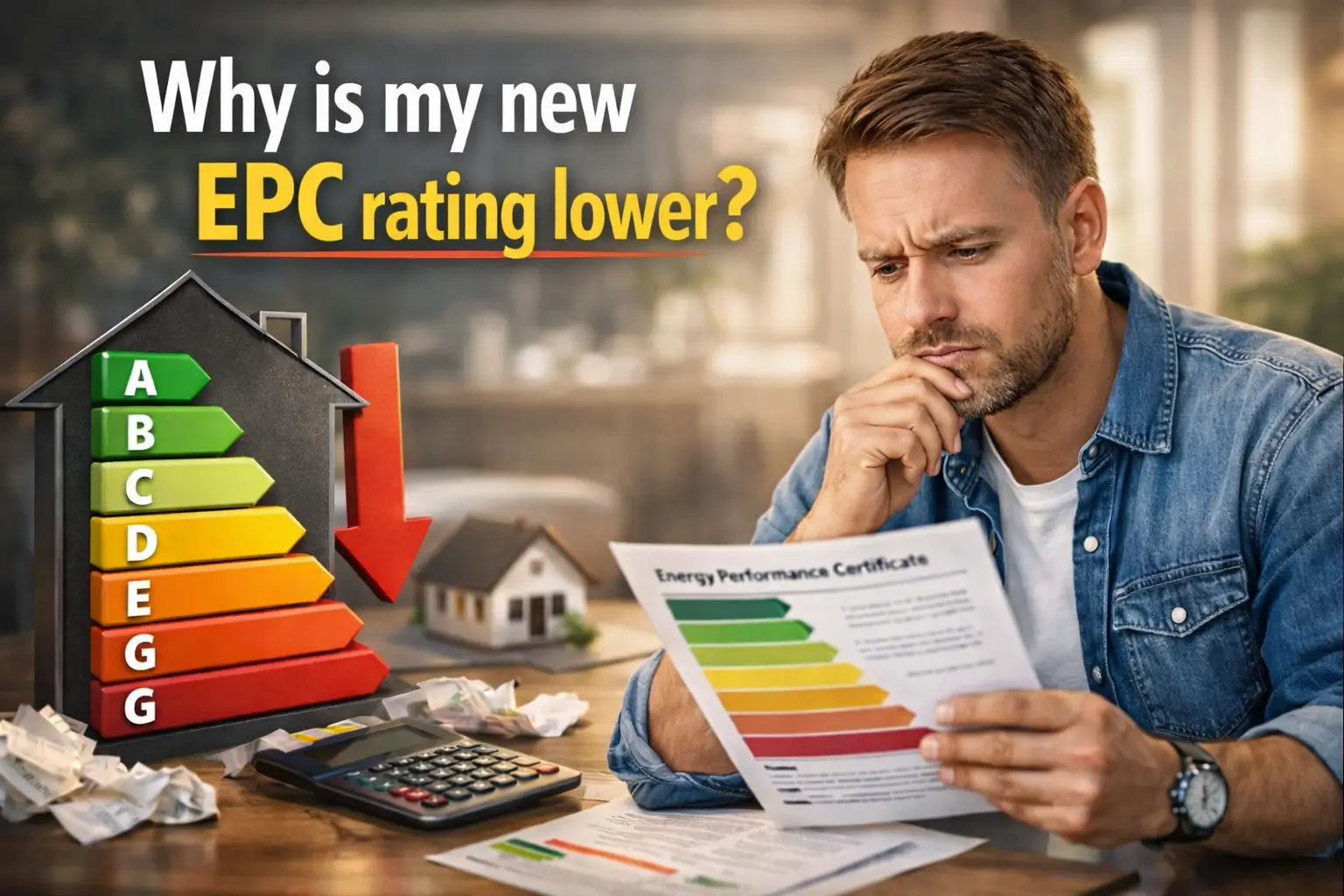
Why Has My EPC Rating Gone Down?

The top 5 reasons why your EPC ratings may have gone down.

There are many reasons why your epc rating has gone down. The top 5 reasons are:

  1. You’ve changed the heating system to a more expensive source of heating, for example from storage heaters to panel electric heaters that use peak rate electricity.

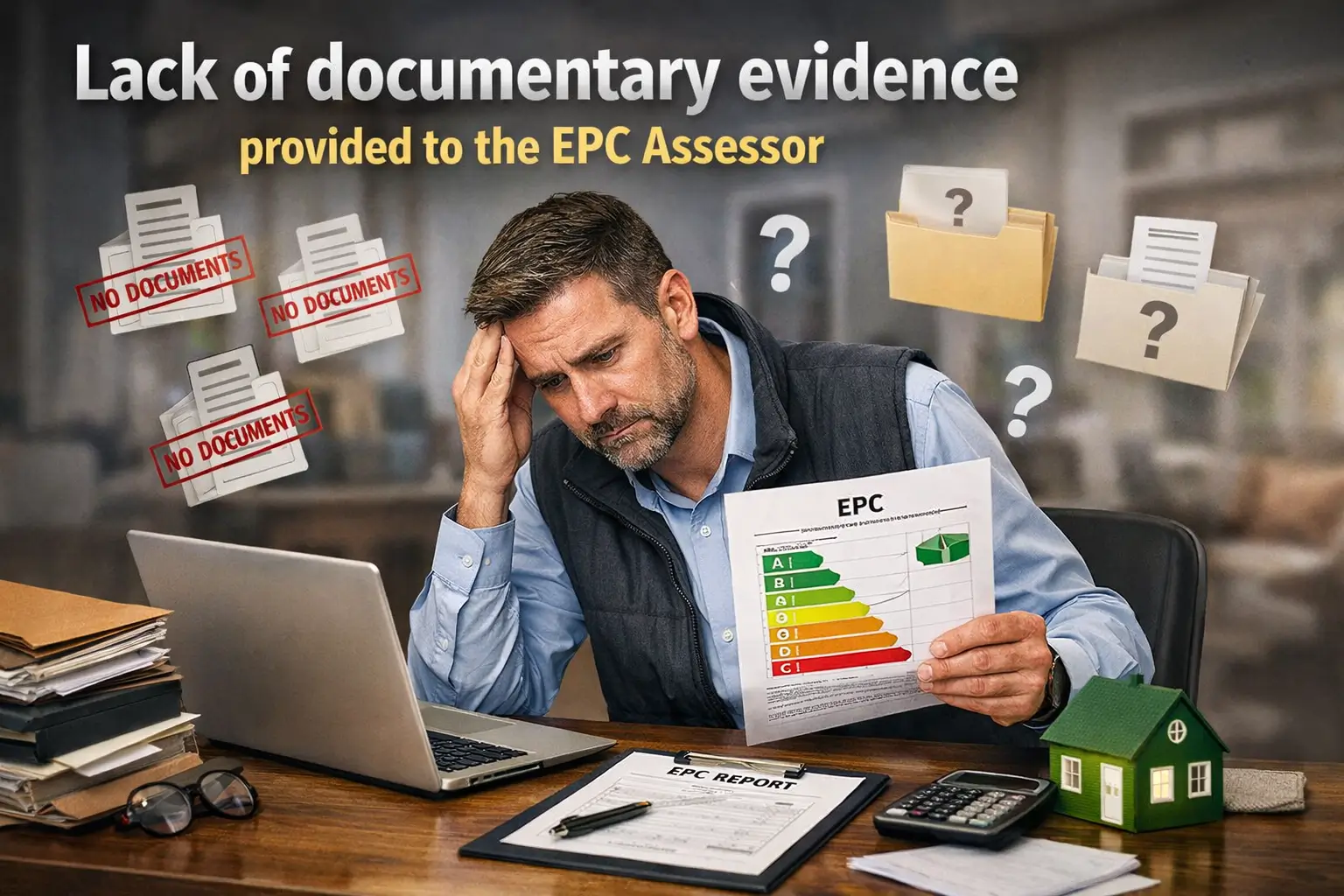
  2. Lack of documentary evidence provided to the EPC Assessor

  3. Data entry error by the Assessor on the old EPC Certificate

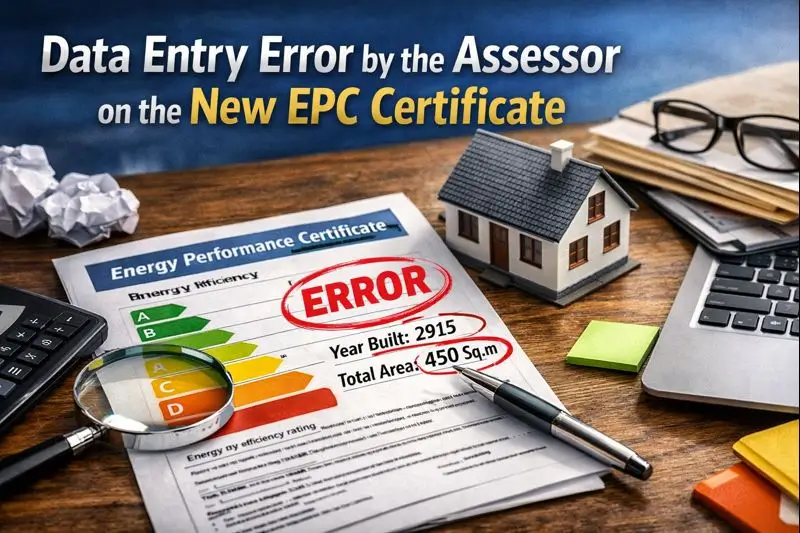
  4. Data entry error by the Assessor on the new EPC Certificate

  5. You have a new build property that has had a new EPC

Now let’s look at each of the above in more detail.

1. You’ve changed the heating system to a more expensive source of heating

Two types of heating systems usually score very low on an EPC: peak rate electric and LPG (liquid propane gas).

If you switch your heating to one of these fuels, the EPC rating will likely drop. This is because they are the most expensive ways to heat a home, and EPC ratings take into account the running costs for heating and hot water.

If a property also has poor insulation along with an expensive fuel source, it may not even reach the minimum E rating required by law.

A common example is replacing storage heaters on an off-peak tariff with panel electric heaters that use electricity at peak rate.

Solution

If possible, switch to a cheaper energy source and improve insulation in poorly insulated parts of the home.

The Nottingham Energy Partnership offers a helpful domestic fuel price comparison on their website, where you can see the cost of different fuel types in pence per kWh.

2. Lack of documentary evidence provided to the EPC Assessor

Lack of documentary evidence is one of the major reasons why your EPC rating may be lower. Whereas your previous EPC Assessor may have had evidence to support a particular data entry, your new EPC cannot simply copy that information, the current Assessor will also need to take copies of documentary evidence.

Documentary evidence needs to be provided where an Assessor cannot see an improvement that has been carried out. This typically applies to upgrades in the following areas of the home:

• Internal or external wall insulation

• Sloping roof insulation

• Flat roof insulation

• Underfloor insulation

• Date loft conversion was carried out

Restricted Access to key areas needed for the EPC

In most cases the Assessor will come across most items they need to see whilst going around the property. However sometimes it may be difficult to gain access to these items which will lead to a lower rated EPC.

 Loft Access

• Boiler Access

• Hot water cylinder access

• Boarded lofts where the insulation depth can’t be determined.

Solution

Keep proof of any insulation work done, such as a receipt, invoice, or contractor’s plan showing what was installed and the thickness of the insulation.

The evidence should also include the property address.

For loft conversions, a building control completion certificate is a strong form of evidence.

If access to certain areas is limited, make sure that the proof you provide still clearly shows the work that was done.

3. Data entry error by the Assessor on the old EPC Certificate

Everyone can make mistakes, and sometimes an Assessor may enter data incorrectly.

However, don’t automatically assume that an old EPC with a higher rating was correct.

EPCs became a legal requirement for properties being sold or rented in May 2010. When the scheme first started, some early EPCs were not very accurate. In 2012, all Assessors had to re-register and retrain to improve standards.

Today, EPCs are carried out to a higher standard using consistent methods for all Assessors. Assessors are also regularly checked by their accreditation body to maintain quality.

This means that a new EPC often corrects errors from older EPCs done over 10 years ago.

Solution

Ask your Assessor to provide information as to what has caused the variation in the EPC rating.

4. Data entry error by the Assessor on the New EPC Certificate

Again, a data entry error could have been made by the new Assessor. However, it is more likely that the error was made on the old certificate.

A recent example we had of this was a customer who raised the query as to why their previous EPC was rated a D 62 whereas the one we had just completed rated the property an E 54 for their mid terrace home.

Our investigation highlighted a glaring error on the old EPC which measured the floor area of the building at only 33m2 when in fact it was 76m2.

This had the impact of the old EPC having a lower running cost per m2 and hence an incorrectly higher rated EPC.

Solution

Ask your new Assessor to check the reason as to why the newer EPC may be lower.

If the Assessor find any errors they have made, the EPC should be corrected free of charge.

The Assessors contact details can be found on the last page of the EPC.

5. You have a new build property that has had a new EPC

New build properties are constructed to very high standards. The first EPC for a new build is produced from the building plans using a method called SAP.

SAP, or Standard Assessment Procedure, is the UK government’s way of calculating a building’s energy efficiency.

EPCs produced using SAP are very accurate because they use exact thermal values for all parts of the building, such as walls, roof, floors, and windows.

New builds also have to meet strict low CO2 emission targets set by building regulations. To achieve these targets, builders often use thermal values higher than the minimum required.

When the SAP EPC expires, a new EPC must be produced using a method called RDSAP.

RDSAP, or Reduced Data Standard Assessment Procedure, is used for existing properties because full thermal data is usually not available. It uses default values for walls, roof, floors, and windows based on the minimum building standards for the property’s age.

If a property was built with higher thermal values than the minimum, RDSAP does not take this into account, which can result in a lower EPC rating.

Air Tightness Testing

Another reason a new build may get a lower EPC rating later is because of air tightness. At the end of construction, new builds have an air tightness test, and the exact result is used in the SAP calculation.

Most new builds achieve an air tightness result between 4 m³/h·m² @ 50 Pa and 7 m³/h·m². Lower numbers are better.

Existing buildings cannot easily have this test done, so RDSAP uses a default value of 15 m³/h·m² @ 50 Pa, which is much higher and less efficient than what the property may have achieved when new.

The combination of differences in thermal values between SAP and RDSAP, along with the default air tightness value, usually lowers the EPC rating by 2–3 points.

Solution

There is no real solution to this one, because the homeowner would typically have no full architectural drawings of their home.

Leave a Reply

Your email address will not be published. Required fields are marked *

EPC Form (Whole website)